
When Water Damage Turns Into Mold in Miami
Almost every mold job we see started as a water job: a leak, a flood, a storm. The difference between the two is mostly time. This page explains how fast mold follows water damage in a Miami home, what to do in the first 24, 48 and 72 hours, and the point at which a water job legally becomes a mold job in Florida.
The clock: 24, 48 and 72 hours
The first 24 hours are for stopping and removing water. Shut off the source if you can, get standing water out, and start drying. The EPA's guidance is to dry water-damaged areas and items within 24 to 48 hours to prevent mold growth — inside that window, a water problem can stay a water problem. This is the stage our water extraction and water removal services exist for.
Between 24 and 48 hours, mold spores that are already in every home's air begin colonising the materials that are still wet — drywall paper, wood, carpet backing, the dust inside wall cavities. Nothing may be visible yet. Materials that are still damp at the end of the second day are the risk set, and in Miami they are often still damp: the same humidity that feeds mold slows evaporation, and an air-conditioned interior can hide a wet wall cavity behind a dry surface.
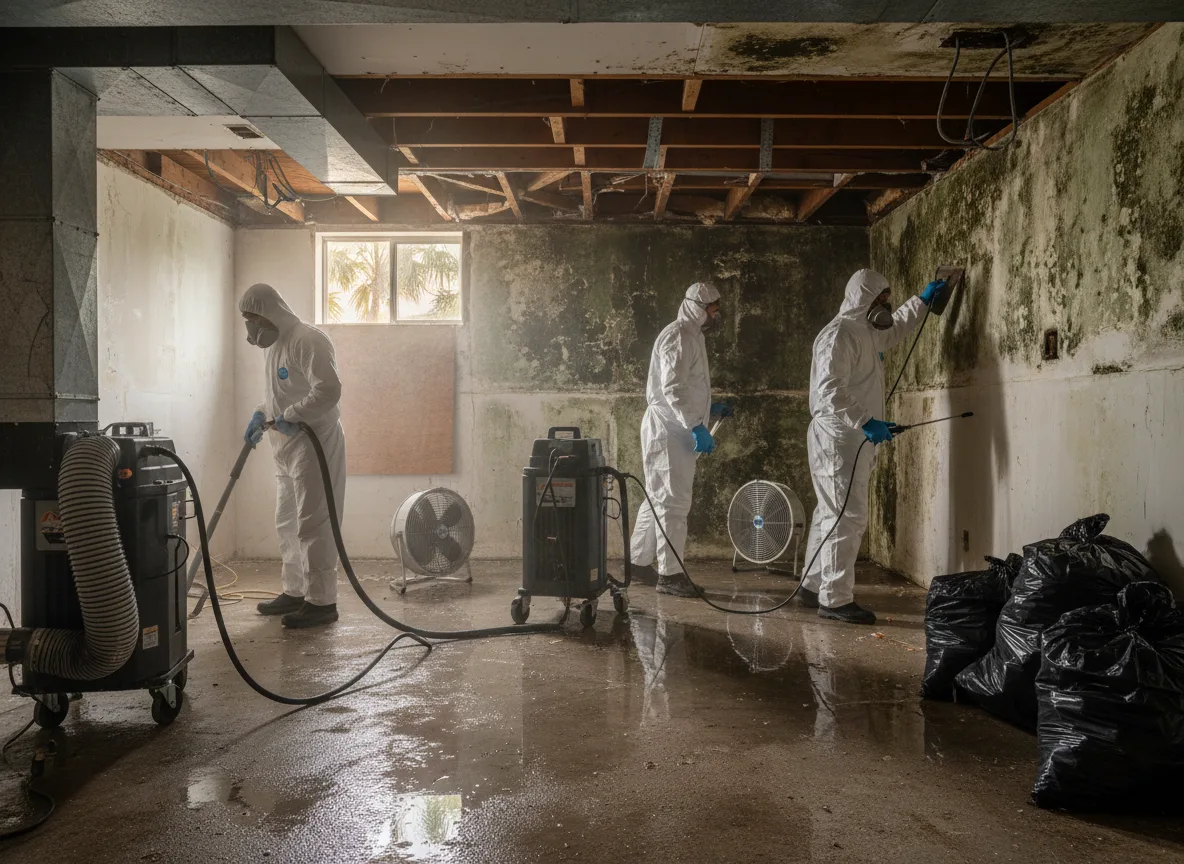
Past 48 to 72 hours, growth on porous material is likely rather than possible, and the first sign is often smell — a musty odour in a room that was flooded or leaked on days earlier means water stayed somewhere it should not have. From here the work changes character: it is no longer only drying, it is removing colonised material, which is mold removal and remediation.
Why Miami shortens the clock
Three local facts compress the timeline. The air is humid most of the year, so wet material dries slowly without equipment. Air conditioning runs constantly, and a condensate line that blocks or a drain pan that overflows puts water inside walls and ceilings quietly, sometimes for weeks — which is why water leak detection matters as much as the cleanup. And much of the housing stock in the communities we serve was built before modern plumbing and roof standards, so small failures are common and often old by the time they show. Storm surge and king tides add the sudden version of the same problem, handled under storm damage restoration.
When a water job becomes a mold job under Florida law
Florida draws the line by size. Under section 468.8411, mold growth greater than about 10 square feet is mold assessment and mold remediation as the statute defines them, with licensing attached. Under section 468.8419, the assessor and the remediator on the same structure must be separate within 12 months — the company that tests cannot be the company that removes it. Below that line, with the moisture source fixed and the area dried, the EPA's position is that most homeowners can clean up themselves. The practical reading: dry fast and the law never enters it; arrive late to a bigger growth and the job needs an independent assessor, a written scope, and a licensed remediator — the sequence our water restoration work hands over to.
Good to know
Common questions
How fast does mold grow after water damage?+
On wet porous material — drywall, wood, carpet backing, ceiling tile — mold can begin growing within 24 to 48 hours, which is why the EPA's guidance is to dry water-damaged areas within 24 to 48 hours to prevent growth. In Miami's humidity the materials also dry more slowly on their own, so the window is shorter in practice than the same leak in a dry climate.
What should I do in the first 24 hours after a leak or flood?+
Stop the water if you can do it safely, move what can be moved out of the wet area, and get standing water out and air moving. Photograph everything before you move it — the water service pages on this site explain what insurers ask for. Then call: extraction and drying in the first day is what keeps a water job from becoming a mold job.
When does water damage become a mold remediation job in Florida?+
When the growth passes about 10 square feet. Section 468.8411 defines mold assessment and mold remediation at growth greater than 10 square feet, and section 468.8419 keeps the assessor and the remediator separate, so a larger job needs an independent assessor as well as a remediator. Under that size, with the moisture source fixed, many homeowners can clean up themselves.
Who do I call first — a water damage company or a mold company?+
Call for the water first if water is still present or materials are still wet: source, extraction and drying come before anything else, because mold treatment on a still-wet wall fails. Mold Removal Miami FL runs the water services and the mold service as one sequence, so the handoff happens inside a single job rather than between two companies.